


Plants with a healing effect >>>> Medicinal geranium - types and properties
Medicinal geranium - types and properties.

For flower growers, it will be a kind of disorder that such a favorite indoor and balcony plant, like Geranium, is not suitable for medicinal purposes - it is an exclusively ornamental plant called Pelargonium. But among the Geraniaceae family, there is one type of Pelargonium - Pelargonium roseum, which is suitable not only for admiring, but also for useful consumption, and three wild species of Geraniums - wild or cultivated, but street plants that nature has endowed with useful properties used in herbal medicine. These are Forest Geranium (Geranium silvaticum L.), Meadow Geranium (Geranium pretense L. and Geranium sanguineum L.) and Marsh Geranium (Geranium palustre L.).
All three wild-growing species of Geraniums have peculiar medicinal properties and help in different ways in case of ill health.
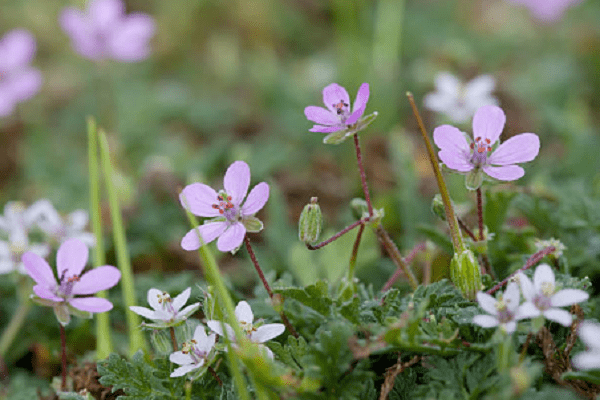
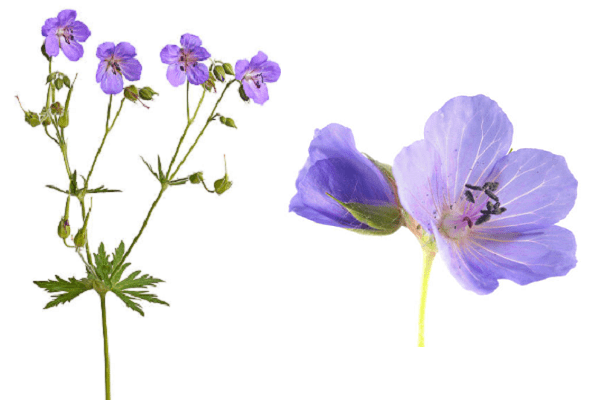
Geranium Forest is a plant used primarily as an external remedy. Decoctions and infusions for baths, baths, compresses, applications are prepared from the upper part of the plant (leaf petioles and the leaves themselves, stems). Such lotions and baths are used for rheumatic diseases (joint pain), for general ailments associated with chills, increased sweating, rinse the scalp and skin for non-infectious skin diseases, make rinsing mixtures for washing ears, rinsing the mouth.
Forest Geranium resembles Marsh Geranium in terms of its growth characteristics - it loves swampy soil and the coastal zone of water bodies (forest streams, lakes, rivers). To grow such a plant in your garden, you will need a peat-humus mixture and waterlogged soil.
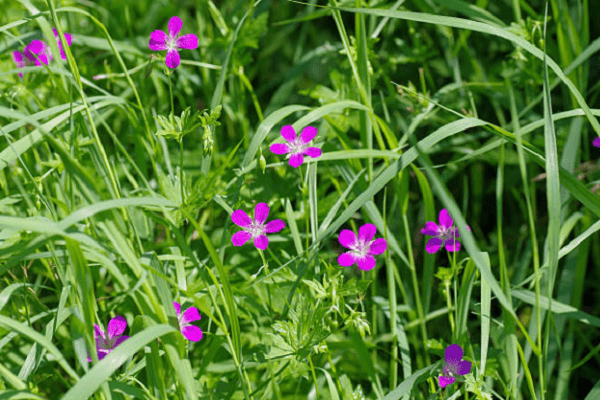
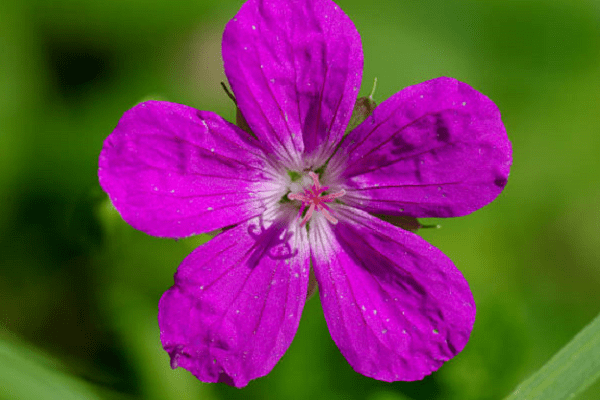
Forest Geranium and Geranium Marsh are outwardly similar to each other: plant growth reaches 24 -28 inches, both plants have small purple flowers, seeds in a box resembling the head and beak of a crane in appearance, for which both varieties of Geranium received the household name "Crane".
A decoction of dried and ground Geranium roots (Forest geranium, Marsh geranium) can be used as a local antiseptic (for injuries of the oral mucosa, for gingivitis, inside for microbial diarrhea or dyspeptic disorders - it inhibits the harmful intestinal microflora).
As a gargle for the mouth and throat during periods of respiratory infections, strong infusions of dried leaves, stems and roots are used externally (do not swallow).
Weak solutions and infusions of Forest Geranium and Marsh Geranium can be used to wash the eyes in case of inflammatory diseases of the mucous membrane of the eye (eyelids) and purulent diseases of the eyes.
Meadow Geranium has almost the same appearance as its relatives, but the size of the plant is different - this is a taller plant, although it belongs to the creeping plant, since without support the stem is not held straight, but tries to rely on neighboring plants and slightly wrap around them. The flowers of the plant are colored bluish-purple (Geranium pretense L.) or blood-red (Geranium sanguineum L.).
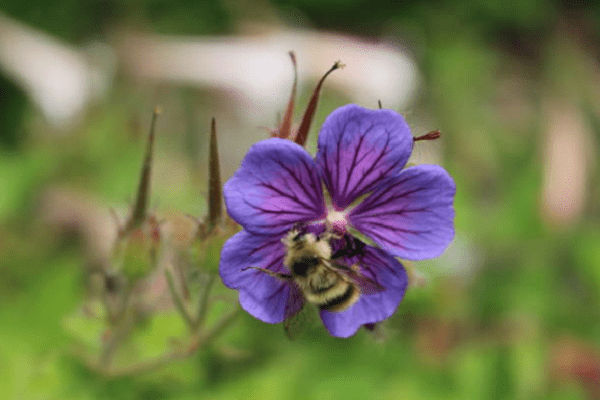

This is the most common type of medicinal Geranium - it is found everywhere (along fences, in open forest areas, in meadows, in fields, in vegetable gardens as a weed). This type of Geranium has healing properties not only of the aerial part of the plant, in particular the rhizomes have medicinal value. From the roots of the Meadow Geranium, rinses, applications, baths are prepared to relieve inflammation, stop capillary bleeding, disinfect wounds, scratches, and scuffs. Such properties of Meadow Geranium are suitable for diseases of the oral mucosa, nasal cavity, urogenital area, skin diseases of infectious and non-infectious origin.
Water extracts and infusions of Meadow Geranium are rich in tannins and alkaloids that excite and depress the nervous system. Stronger infusions are used for the tonic and stimulating effect of the nervous system with a general reduced body tone, reduced immunity. Weaker infusions are used as sedatives for sedation and for insomnia.
The collection of the aboveground part of the Geranium plant (Lesnaya, Bolotnaya, Lugovaya) is carried out in the period just before the beginning of flowering (it is possible at the budding stage). Next, flowers are collected for infusions, and the faded plant is dug out closer to autumn to collect rhizomes.
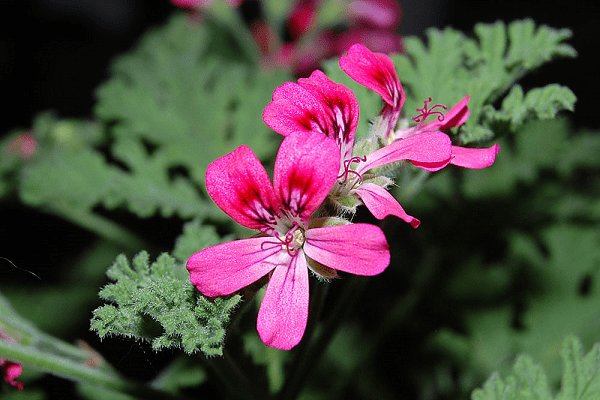

Regarding Pelargonium Pink, it should be noted that this plant belongs to cultivated essential - oil plants, but it is surprising that the highest level of oils is not found in the petals and seeds of the plant, as is usually the case, but in the leaf stalks and leaves of Pelargonium Pink themselves. These oils (oily extract) have a very pleasant aroma, similar to the smell of Rose, and are used to flavor drinks (teas, infusions, compotes, jelly, preserves and jams, syrups, homemade wines, cocktails), baked goods and sweets (creams, sweets, ice cream, toppings), salads, sweet sauces and gravies.
The aromas exuded by the leaves of the Pelargonium Rose plant resemble the action of phytoncides of some plants and can serve as a therapeutic cause only as a weak essential antiseptic, and the oils themselves extracted from the plant have a tanning effect, which can be used for external applications on the mucous membranes of the mouth, nose and skin. The only exception is the mucous membrane and skin of the eyelids, where such oils are not used in order to avoid burns to the delicate tissue structure. Pelargonium Rose oils can be used for oil rinsing and inhalation.
In addition to their medicinal properties, all of the listed types of Geraniums are honey plants and endow honey with medicinal properties (for example, antiseptic).












Read
Read













