


Urology >>>> Descent of the kidney
Descent of the kidney.
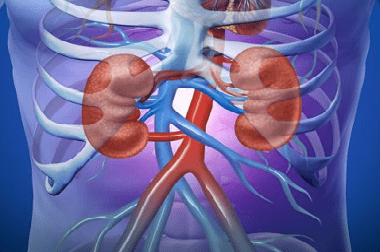
The kidneys, like other internal organs, have their stable location inside the human body and are attached to the surrounding tissues and anatomical structures due to the renal fascia - connective tissue sheets that form a suspension attachment; due to fatty tissue, which fixes the kidney and protects it from injury; due to the abdominal ligaments that hold the kidney in a certain position. When the human body moves, the kidney can deviate from its location to the sides by an average of 3 cm, but under pathological influences (injuries, weight loss, vibration sickness, excessive sports loads, after childbirth), the fixing and stabilizing structures of the kidney are weakened and create conditions for its movement.
The descent of the kidney (nephroptosis) is associated with a number of unpleasant consequences that provoke the development of another kind of disease:
- With excessive displacement of the kidney, the vascular bundle is stretched, bleeding may appear, portal hypertension may develop;
- A lowered kidney deforms the ureter, which disrupts the outflow of urine and causes stagnation in the bladder, which in turn causes inflammation in the kidney parenchyma and contributes to the development of hydronephrosis, pyelonephritis, and urolithiasis.
Signs of kidney descent depend on the extent to which the kidney has been displaced relative to its location:
- At the initial stages of the descent of the kidney (up to 7 cm), there may be no symptoms other than the availability of the kidney for palpation (when inhaling, you can feel the lower edge of the kidney). Sometimes there is a feeling of heaviness in the hypochondrium.
- Descent of the kidney more than seven centimeters causes pain (dull pain radiating to the lumbar region), which pass in a horizontal position of the body or at rest.
- With further descent of the kidney, the pain gains intensity, it can resemble renal colic, with physical exertion or with a sharp change in body position, it can increase. The kidney is palpated by 2/3. Urine tests show an increase in the level of protein and red blood cells as a result of congestion in the kidney.
- If the entire kidney falls below the costal arch up to the level of the small pelvis, then pain symptoms may be accompanied by nausea and urge to vomit, the pain does not go away when the position of the body is changed, fornical bleeding and renal hypertension may develop. In this case, in addition to pain, a person experiences excessive excitability, suffers from insomnia, and may become depressed.
Diagnosis of descent of the kidney is carried out on the basis of urography - X-ray examination using the introduction of a contrast agent. With significant descent of the kidney, additional studies of the vascular bundle of the kidney are performed to detect violations in the renal blood supply.
Treatment of kidney descent depends on the level of kidney displacement and at the initial stages with minor displacements is conservative. The urologist recommends to give up carrying weights and significant physical exertion; change the structure of food and gain additional weight so that the kidney "overgrown" with fatty tissue; wear a bandage that supports the peritoneal and pelvic organs.
In case of significant descent of the kidney, a surgical intervention is performed - suturing the kidney (nephropexy), the purpose of which is to attach the kidney to closely located organs (fascia of adjacent organs, muscles, ribs).












Read
Read













