


Emergencies >>>> Bruising or hematoma with bruises
Bruising or hematoma with bruises.
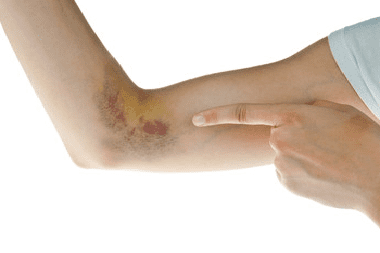
The most common injury to soft tissues and organs without violating their integrity is contusion . It can be considered as an independent injury or combined with various types of injuries: abrasions, dislocations, fractures, crushing of tissues, concussion and even ruptures of tissues and organs.
As a result of a bruise of soft tissues or organs, blood vessels rupture, and blood pours out into the space surrounding the vessel, filling it to certain boundaries and shining through the skin. What we see as a result at the site of the injury is called a hematoma (the common name for a subcutaneous hematoma is a bruise). Often, hematomas are not visible to the eye, for example, with bruises of internal organs.

The volume of blood poured into the interstitial space and the extent of this space depends on the size and number of damaged vessels. The more extensive the hematoma, the more vessels were involved in the injury and / or the larger was the size of the ruptured vessel. The redder the color of the hematoma, the more blood poured into the interstitial space.
First aid for bruises and hematomas.
First aid for a bruise is to provide cooling of the bruised area (a hot water bottle with cold water, ice cubes in a plastic bag, a plastic sealed container with cold water will do). This maneuver stimulates the vasoconstriction at the site of the injury, and the amount of blood flowing out will be less. The cold is kept for half an hour, then a break for 10 minutes and cold is applied again. This procedure is carried out only in the first few hours after the injury. And she's useless the next day.
When a limb is bruised, it is given an elevated position, which promotes the outflow of blood and reduces the size of the hematoma.
The next step in first aid is a pressure bandage on the site of the injury. It will also help to stop the flow of blood from the vessels.
The last thing that can be done in a domestic environment is the application of an ointment that accelerates the resorption of the hematoma . All ointments for such a case have a different chemical composition and, accordingly, have side effects in addition to their main purpose. Therefore, when choosing an ointment, it is necessary, while reading the instructions for it, to pay attention, first of all, to the description of contraindications and side effects and correlate them with your state of health and diseases. The action of any ointment can not so much help with resorption of the hematoma, but exacerbate another disease. Be careful!
Here are some examples of ointments used for resorption of hematomas:
- Heparin ointment or ointments containing heparin (Lioton gel, Dolobene-gel)
- Traxivazine for resorption of hemorrhages
- Febrofid, Nise, Voltaren, Diclofenac relieve local tissue inflammation around the hematoma
Bodyaga in powder (dissolves to a mushy consistency with boiled water at room temperature). It is necessary to work with the bodyagi with gloves, since it is a powder consisting of small needles.
Physiotherapy will speed up the process of resorption of subcutaneous hematomas, but they can be used 3-5 days after injury. Prescribe magnetotherapy, laser therapy, UHF.
Please note that all ambulance measures for a bruise are provided in stages, and not simultaneously. First, a period of cooling and a pressure bandage, then the application of ointments and the last stage is physiotherapy. If the hematoma is serious, then ointments are not recommended before visiting a doctor, so as not to distort the picture of the development of the traumatic process.
In what cases a hematoma will require medical intervention.
The size and appearance of a hematoma is the first indicator of the severity of the injury. Small hematomas, as a rule, are not dangerous (unless we are dealing with a contusion of the eye or brain , in this case, any size of the hematoma and its location must be correctly assessed from the point of view of the threat to health, but this is already the task of a qualified specialist).
Small, non-extensive, visible hematomas (dark red or blue, not too swollen) will resolve themselves rather quickly. But what to do if the hematoma is extensive and / or threatening (burgundy-red, excessively convex). Such a hematoma itself does not quickly resolve. In this case, you will need professional medical attention. And to fight the hematoma - this will be the task of the doctor - surgeon. A puncture or incision and drainage of the hematoma may be prescribed to speed up blood flow and reduce the amount of inflammation surrounding the hematoma.
A dangerous option is if an infection with blood flow gets inside the hematoma . Then the healing process can be delayed, and in serious cases lead to the development of tissue suppuration at the site of the injury. In this case, the help of professionals is also needed (prescription of antibiotics and various surgical procedures).
Another dangerous option, when you notice that the hematoma continues to increase in size, this indicates that a too large blood vessel (possibly an artery) is damaged and the blood will not stop on its own. In this case, surgical intervention is required in order to perform an operation to suture the vessel, so contact a medical institution immediately !












Read
Read













