


Oncology >>>> Esophageal cancer, symptoms and treatment
Esophageal cancer, symptoms and treatment.
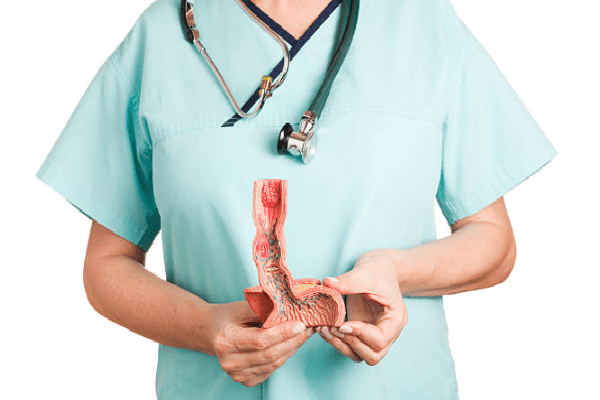
Esophageal cancer is not in the first place in the statistics of cancer, but, nevertheless, it is quite common, especially in the elderly.
Most often, esophageal cancer develops in places where the esophageal tube naturally narrows. The most characteristic location of the tumor is considered to be the middle third of the thoracic esophagus, less often a tumor of the lower third of the thoracic esophagus. The development of esophageal cancer is distinguished by a variety of forms of tumor growth: exophytic, endophytic, saucer-shaped.

An exophytic tumor grows into the lumen of the esophagus in the form of a node, has clear boundaries. The membrane of such a tumor is poorly developed, therefore, the tumor is soft to the touch and easily disintegrates.
An endophytic tumor has a well-developed membrane, dense, whitish in color. It covers the walls of the esophagus in the form of a sleeve, sharply narrowing its lumen.
A saucer-shaped tumor looks like an ulcer with raised roller-like thickened edges. It is characterized by early decay and infiltration of the walls of the esophagus outside the tumor.
Factors provoking the development of esophageal cancer:
- overly hot or overly cold food
- swallowing poorly chewed food in large chunks
- drinking strong alcoholic beverages
- smoking
- chewing tobacco
- lack of vitamins (A, B, C, E) and trace elements (folic acid, selenium, molybdenum)
- predominance of smoked meats in food (meat and fish), stroganin
- chronic diseases of the esophagus (gastroesophageal disease - provokes the release of acid into the esophagus; esophageal dyskinesias, polyps - impede the passage of the food bolus and cause injury to the esophageal wall)
- thermal or chemical burns
- fumes and dust of harmful chemicals
- genetic predisposition
Typical clinical signs of esophageal cancer are:
- Dysphagia (difficulty passing food through the esophagus as a result of narrowing of the lumen and / or reflex spasm)
- Feeling obstructed when passing the food bolt
- Putrid odor from the mouth
- Hypersalivation (profuse salivation)
- Regurgitation and esophageal vomiting
Other symptoms may occur if the tumor is involved in the vagus nerve, recurrent laryngeal nerve, trachea or bronchi are compressed. This happens when the tumor extends beyond the esophagus, grows into the mediastinum and chest organs.
Thus appear:
- Cardiac disorder (vagus nerve affected)
- Hoarseness of the voice (with paresis of the larynx, when the recurrent laryngeal nerve is affected)
- Cough, shortness of breath (trachea and bronchi affected)
Dysphagia can vary in severity:
- Obstructed passage of solid food through the esophagus
- Semi-liquid food is difficult to pass
- Difficulty passing liquid food
- Food does not pass - complete obstruction of the esophageal tube lumen.
Esophageal cancer is treated with radiation therapy and surgery.
Radiation therapy is indicated for tumor localization in the upper third of the thoracic and cervical esophagus.
Mixed treatment (radiation and surgical) is carried out when the tumor is located in the middle third of the thoracic region.
Surgical treatment is carried out when the tumor is located in the abdominal region and the lower third of the thoracic region.
Surgical intervention is performed if there are no contraindications to it. Preference is given to operations with one-step restoration of the continuity (with simultaneous plastic surgery) of the digestive tract.
There is the so-called palliative treatment, when in the latent form of the course of the disease, in the early stages of the disease, with late referral or elderly patient's age, radical treatment is not always possible. Palliative treatment for esophageal cancer includes gastrostomy (a tube is taken from the stomach to the outside in the abdomen and fed through it) or endoscopic recanalization of the esophageal lumen (carried out using a laser and electrocoagulation of the tumor).
Survival prognosis for esophageal cancer is ambiguous. Untreated cancer always has a poor prognosis (from 5 months to sometimes 6 years). But esophageal cancer in most cases progresses rather slowly, so it makes sense to use all possible methods of treatment and, most importantly, to carry out early diagnosis of esophageal cancer if suspicious symptoms are found.












Read
Read













